
How the layered safety controls on an unvented hot-water cylinder protect against overheat, and where a discharge ends up.
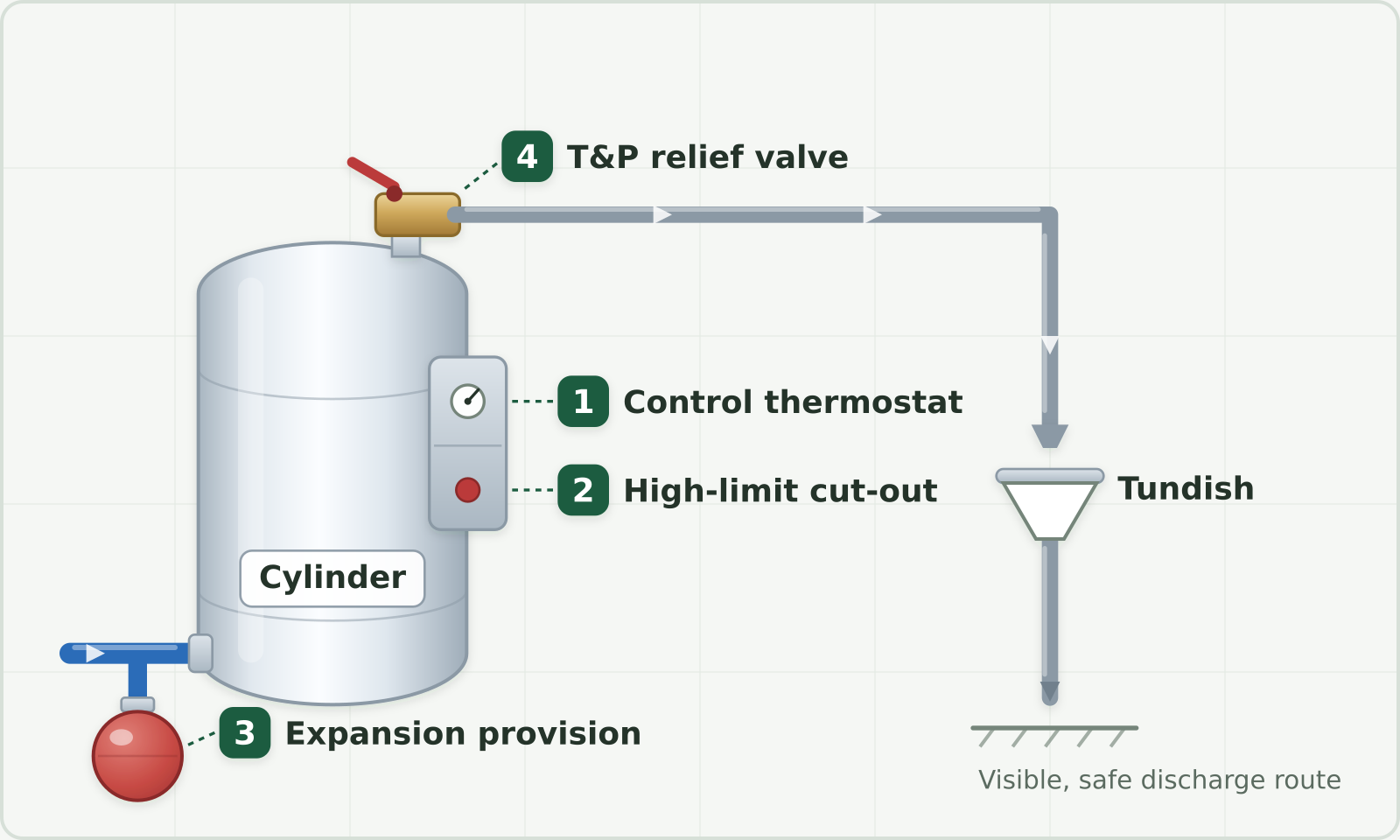
Read the labelled controls on the cylinder as layers of protection: normal temperature control, independent overheat protection and the temperature and pressure relief valve. Expansion provision and the discharge route are shown separately.
The first layer is the control thermostat. In everyday use it holds the stored water at its normal temperature.
If that fails and the water keeps heating, the high-limit (overheat) cut-out interrupts the energy supply. It is designed not to reset on its own, so the fault has to be found and put right.
If heat or pressure still rise, the temperature and pressure relief valve is the final layer. It opens to release water and relieve the cylinder.
Because heated water expands, the system also needs expansion provision: an expansion vessel or an internal air gap, shown to the right of the cylinder.
The example shows relief discharge passing through a tundish, a visible air break, towards a low-level termination. It illustrates the route rather than every installation detail. Other permitted termination arrangements have their own conditions; the complete route must make discharge apparent and protect people from hot water and steam.
Use this as a revision aid for the principle of layered protection. Exact set points, pipe sizes and discharge distances are set by the current Approved Document G, the relevant standards and the manufacturer instructions: always work to those.
Something wrong, unclear or out of date? Report an issue with this note.