
How to tell room-sealed, open-flued and flueless appliances apart: where the combustion air comes from, where the products go, and what each type makes you check.
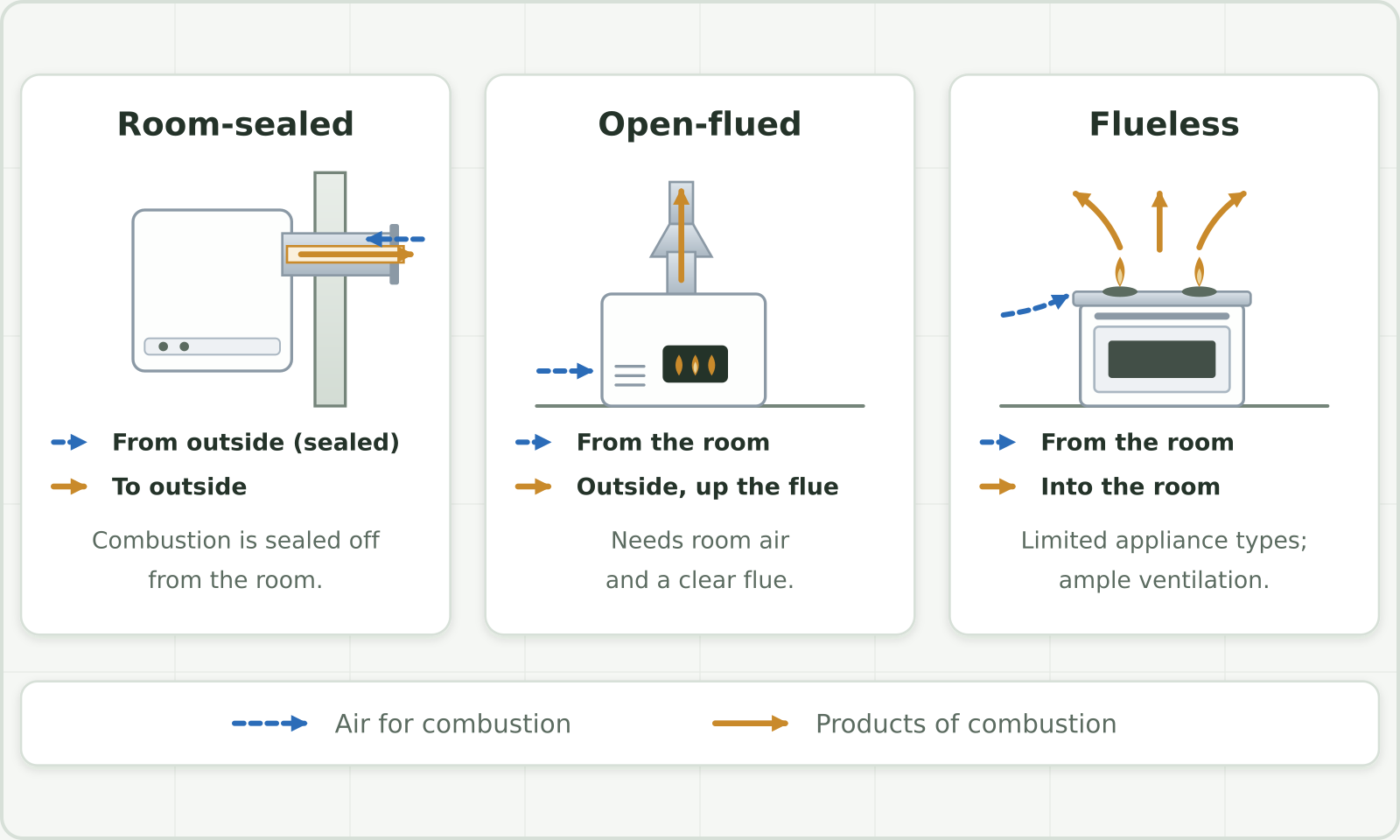
A great deal of gas safety work starts with one question: what kind of flue does this appliance have? The comparison places the three arrangements side by side and answers the same two questions for each — where does the combustion air come from, and where do the products of combustion go?
Room-sealed
A room-sealed appliance takes air from outside and sends products outside through a sealed path, so the combustion is sealed off from the room around it. You commonly meet a concentric terminal, where one pipe sits inside the other, or a twin-pipe arrangement. Because the burning is separated from the room, these are generally less affected by room conditions, and it is the integrity of the case seals, the flue and the terminal that becomes the thing to check.
Open-flued
An open-flued appliance takes its air from the room and sends the products up a flue or chimney to outside. You often recognise one by a draught diverter or a visible flue connection. It depends on enough room air and a clear, working flue, which makes it the type most sensitive to room ventilation and flue condition — and a spillage test is the key proof that it clears its products to outside.
Flueless
A flueless appliance has no flue at all: it takes air from the room and releases the products back into the room. This arrangement is permitted only for suitable appliance types in suitable locations. Room size and ventilation matter, alongside correct combustion, installation and safe functioning; ventilation alone does not establish safety.
Fan assistance describes what moves the air or products. It is not a fourth air-supply category: a room-sealed appliance can also be fan-assisted. Identify the combustion circuit as well as the draught method.
The colour key separates air for combustion (blue) from products of combustion (amber), so the path of each is easy to follow.
The practical habit is to identify the type before anything else, because it points you straight at the checks that matter: outside terminals and seals for room-sealed; room air, flue condition and a spillage test for open-flued; ventilation and the limits on use for flueless.
Treat this as a concept comparison. The detailed rules for each type are in the current Approved Document J, BS 5440 and the manufacturer instructions.
Something wrong, unclear or out of date? Report an issue with this note.